Urine Drug Testing for Cannabis
Urine is by far the most common specimen type for cannabis drug testing. Most workplace, probation, sports, military, and federal testing programs use urine. This page walks through exactly how urine testing works, what the cutoffs mean, what happens in the lab, and how accurate the results are.
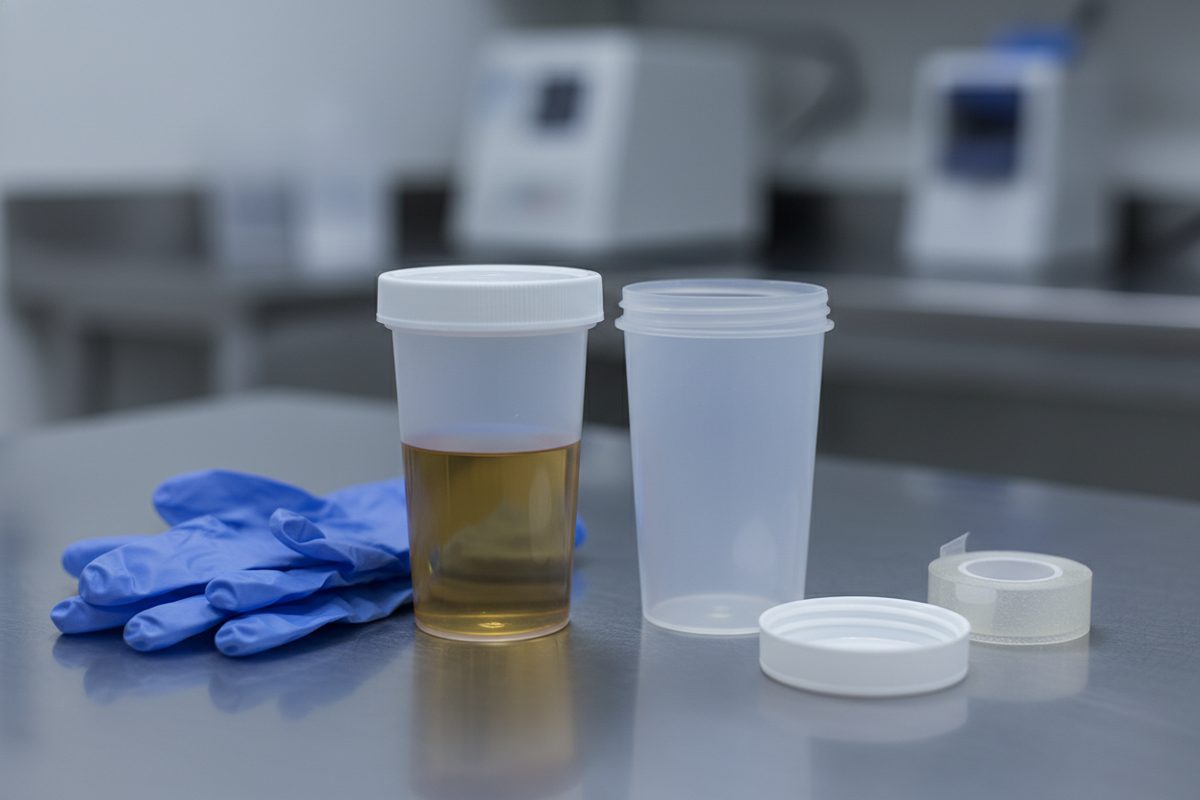
What Urine Tests Detect
Urine drug tests detect THC-COOH (11-nor-9-carboxy-THC), the pharmacologically inactive metabolite of THC. They do not detect THC itself in any meaningful quantity. See THC vs. THC-COOH for the full pharmacology.
This matters because a positive urine test proves past cannabis exposure — not current impairment. A worker who used cannabis on Friday night can be completely sober Monday morning and still fail a urine test.
The Two-Step Testing Process
Step 1: Immunoassay Screening
The initial test is an antibody-based immunoassay. These tests are fast (minutes), cheap ($5–25), and deliver a presumptive result. Common platforms include:
- EMIT (Enzyme Multiplied Immunoassay Technique)
- CEDIA (Cloned Enzyme Donor Immunoassay)
- FPIA (Fluorescence Polarization Immunoassay)
- Point-of-care lateral flow strips (home test kits, instant screening cups)
Immunoassays are designed to turn positive at or above a specific cutoff level. For federal testing, this cutoff is 50 ng/mL THC-COOH. Some employers use different cutoffs: 20 ng/mL (extends detection; used by military and some clinical labs) or 100 ng/mL (shortens detection window).
The immunoassay is sensitive but not perfectly specific. Antibodies designed to recognize THC-COOH can also cross-react with structurally similar compounds, creating the possibility of false positives. This is why a positive screen must be confirmed.
Step 2: GC-MS or LC-MS/MS Confirmation
All positive immunoassay results must be confirmed by chromatographic mass spectrometry:
- GC-MS (Gas Chromatography — Mass Spectrometry)
- LC-MS/MS (Liquid Chromatography — Tandem Mass Spectrometry)
Confirmation tests separate molecules by retention time and identify them by unique mass spectral fragmentation patterns. The result is definitive identification and precise quantification. The federal confirmation cutoff is 15 ng/mL THC-COOH.
The two-step process gives near-zero false positive rates for cross-reactive medications. If you have tested positive via the full two-step process, the result is chemically unambiguous — THC-COOH was in your urine at the reported concentration. What you can still challenge is whether it came from cannabis use (see CBD and positive tests) or whether the chain of custody was intact (see Chain of Custody Challenges).
SAMHSA Federal Cutoffs
The Substance Abuse and Mental Health Services Administration (SAMHSA) publishes the mandatory cutoff levels for federal workplace drug testing. Current cutoffs, published at 88 FR 70768 (effective February 1, 2024):
Non-federal employers are not required to use SAMHSA cutoffs and may set their own. The most common alternatives are:
- 20 ng/mL — extends detection window significantly; common in military and some clinical contexts
- 100 ng/mL — shortens detection window; sometimes used in clinical pain management
The lower the cutoff, the longer the effective detection window. At 20 ng/mL, chronic heavy users can test positive for 67–93 days after last use. See Chronic Heavy Detection Windows.
Accuracy and Reliability
Modern immunoassay cannabis tests have positive predictive values of 92–100% (Moeller et al. 2017, PMID 28012771). GC-MS/LC-MS/MS confirmation has near-zero false positive rates for cannabis. When the full two-step process is followed, the test result is highly reliable as a measure of whether THC-COOH was present in the sample.
Where reliability breaks down:
- Instant screening devices (point-of-care cups) are generally less reliable than lab-based immunoassays, especially at borderline concentrations
- Pantoprazole and a handful of other medications can cause false positives on some immunoassays (though confirmation eliminates this)
- Efavirenz (HIV medication) produces documented false positives on rapid-response tests
- Hemp seed oil at high intakes can produce legitimate-but-unexpected positives
- See False Positives from Medications
Collection Procedure (Federal/DOT)
SAMHSA-compliant collection follows a strict protocol under 49 CFR Part 40:
- Donor provides photo ID and removes outer clothing
- Collection occurs in a single-use, monitored bathroom (directly observed only under specific conditions)
- Minimum specimen volume of 45 mL is required
- Temperature must be verified at 90–100°F within 4 minutes of collection
- Specimen is split into Bottle A (≥30 mL) and Bottle B (≥15 mL)
- Chain-of-custody form is initiated and signed by both donor and collector
- Specimen validity testing checks creatinine, specific gravity, pH, and oxidants
Directly Observed Collections
Under 49 CFR § 40.67, directly observed collections are required for:
- Return-to-duty tests after a positive
- Follow-up tests
- Out-of-range temperature readings
- Extreme dilute results (creatinine 2–5 mg/dL)
- Suspected tampering
The observer (same gender as the donor) watches urination directly, having verified the absence of prosthetic devices or concealment. Refusal to submit to an observed collection counts as a positive result.
Specimen Validity Testing
Labs check every specimen for signs of tampering or dilution:
- Creatinine — normal human urine is 20–400 mg/dL. Below 20 is "dilute"; below 5 triggers mandatory observed recollection; below 2 is "substituted" (not consistent with human urine).
- Specific gravity — normal range 1.003–1.030. Values below 1.003 suggest dilution.
- pH — normal urine pH is 4.5–8.0. Outside this range suggests adulteration.
- Oxidants/adulterants — tests for bleach, chromates, nitrites, glutaraldehyde, and other adulterants.
Approximately 5% of all specimens meet dilute criteria. Quest Diagnostics reported that substituted (cheating) specimens surged to the highest level in 30+ years in 2024 data.
Cost
- Point-of-care instant tests: $5–25 per test
- Lab immunoassay only: $10–40
- Lab immunoassay with GC-MS confirmation: $50–150
- Expanded panels (cannabis plus other drugs): $30–200
Employees typically do not pay; employers bear the testing costs. Probationers usually pay $15–20 per test.